
How Top Singapore Students Break Down Difficult 'O' Level Exam Questions (2026 Guide)
Discover how top Singapore students tackle O Level exam questions with effective comprehension strategies, exam techniques, and past paper insights. Adapted for 2026.

Why O-Level Questions Feel Harder Than They Are
Most O-Level students do not fail because they don't know the content — they fail because they misread the question. Top scorers treat every exam question as a puzzle with three layers: what is being asked, what is being given, and what is being tested.
The current syllabus and exam formats are published by the Singapore Examinations and Assessment Board (SEAB), and they reward students who follow command words precisely. Knowing the difference between describe, explain and evaluate can mean two grade jumps on the same content.
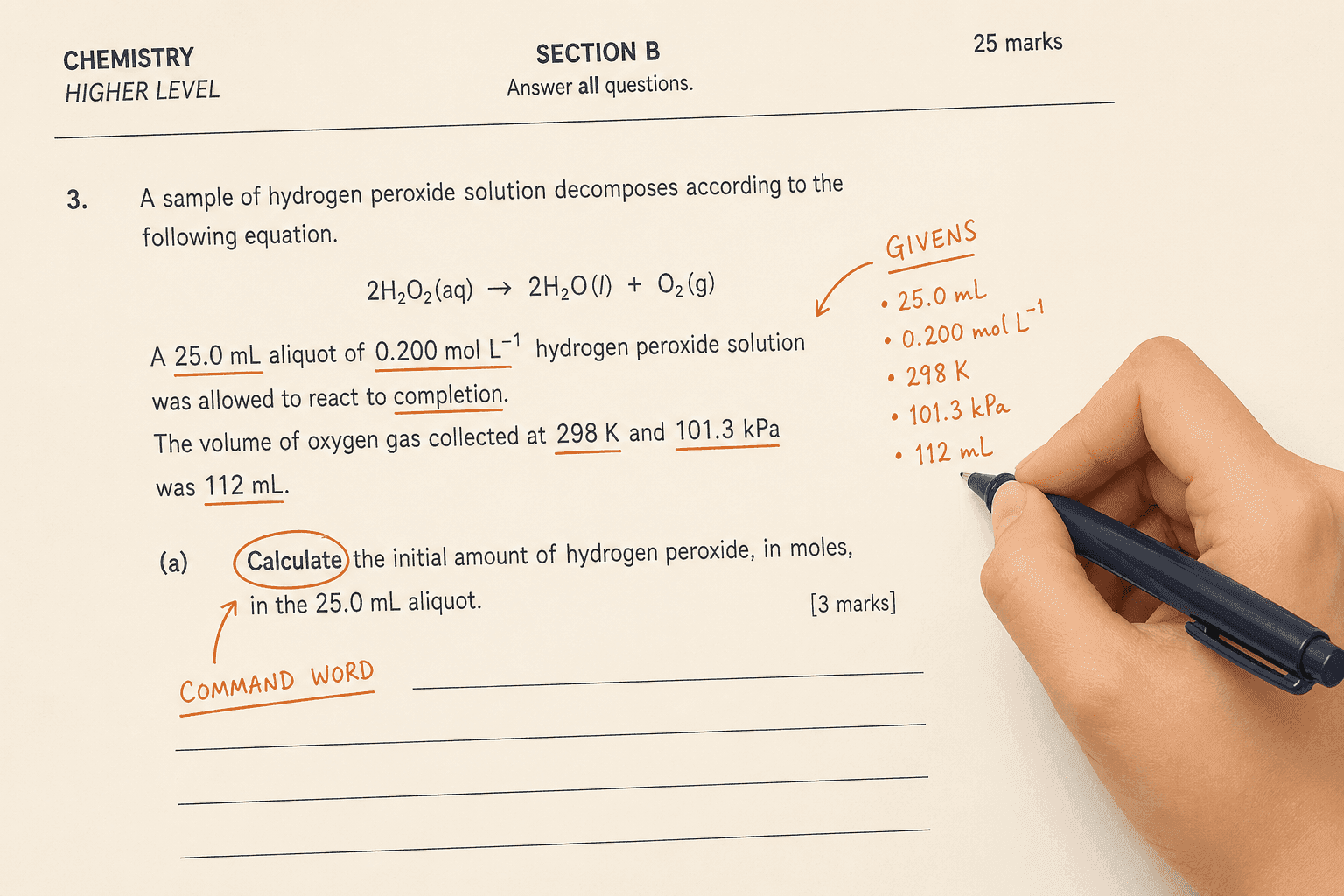
Step 1 — Decode the Command Word First
Before reading the rest of the question, circle the command word. Each command word has a specific marking expectation set by Cambridge Assessment, the partner behind the GCE O-Level. You can read the official guidance in the Cambridge command words document.
- ‘State’ or ‘List’ — one short, factual answer per mark.
- ‘Describe’ — what something is or what happens, no reasons needed.
- ‘Explain’ — give reasons or causes, usually 2–3 connected statements.
- ‘Evaluate’ or ‘Discuss’ — weigh both sides, then take a stand.
Step 2 — Underline the Givens
Top students underline every quantity, condition and constraint in the question stem before they touch the answer. This forces them to use everything that is given, which is exactly what mark schemes reward. If a question gives you a temperature, a pH, or a date, that detail is almost certainly load-bearing.
Step 3 — Plan in 30 Seconds, Then Write
For 4-mark and above questions, a 30-second plan in the margin saves five minutes of rewriting. Sketch the structure: P (point) → E (evidence) → E (explanation) → L (link back to the question). This PEEL structure is the same one promoted by the Singapore Ministry of Education in its English Language teaching guides.
Step 4 — Mine Past Papers Strategically
Practising past-year papers is non-negotiable, but the way you practise matters far more than the volume. Top students do three things differently:
- They time themselves strictly, even on first attempts.
- They mark their own work using the official examiner reports before checking model answers.
- They keep a one-page ‘mistake log’ per subject and review it weekly.
Step 5 — Train for Endurance, Not Just Accuracy
An O-Level paper is a 2-hour cognitive endurance event. If you only ever practise in 30-minute bursts, your accuracy will collapse in the final third of the real exam. In the four weeks before the paper, sit at least three full-length timed mocks per subject under exam conditions.
When to Bring in Targeted Help
If you are stuck at the same grade across two consecutive practice papers, the gap is rarely effort — it is technique. Our O-Level tutors at Gamma Learning Centre run a structured question-deconstruction programme that can be booked here, or you can reach out for a trial lesson.