
How to Build a Study Timetable That Actually Works
Most study plans fail by week two. Our tutors share the scheduling strategies they recommend to every new student — backed by research on spaced repetition and active recall.

Why Most Study Timetables Fail by Week Two
Most students start the term with grand intentions and a colour-coded timetable. Two weeks later, the schedule is buried under unfinished worksheets and CCAs. The problem is rarely discipline — it is design. A timetable that ignores how memory and motivation actually work cannot survive a busy school week.
At Gamma Learning Centre, we coach students to plan around two principles backed by decades of cognitive science: spaced repetition and active recall. Together they make every study hour count two or three times more.
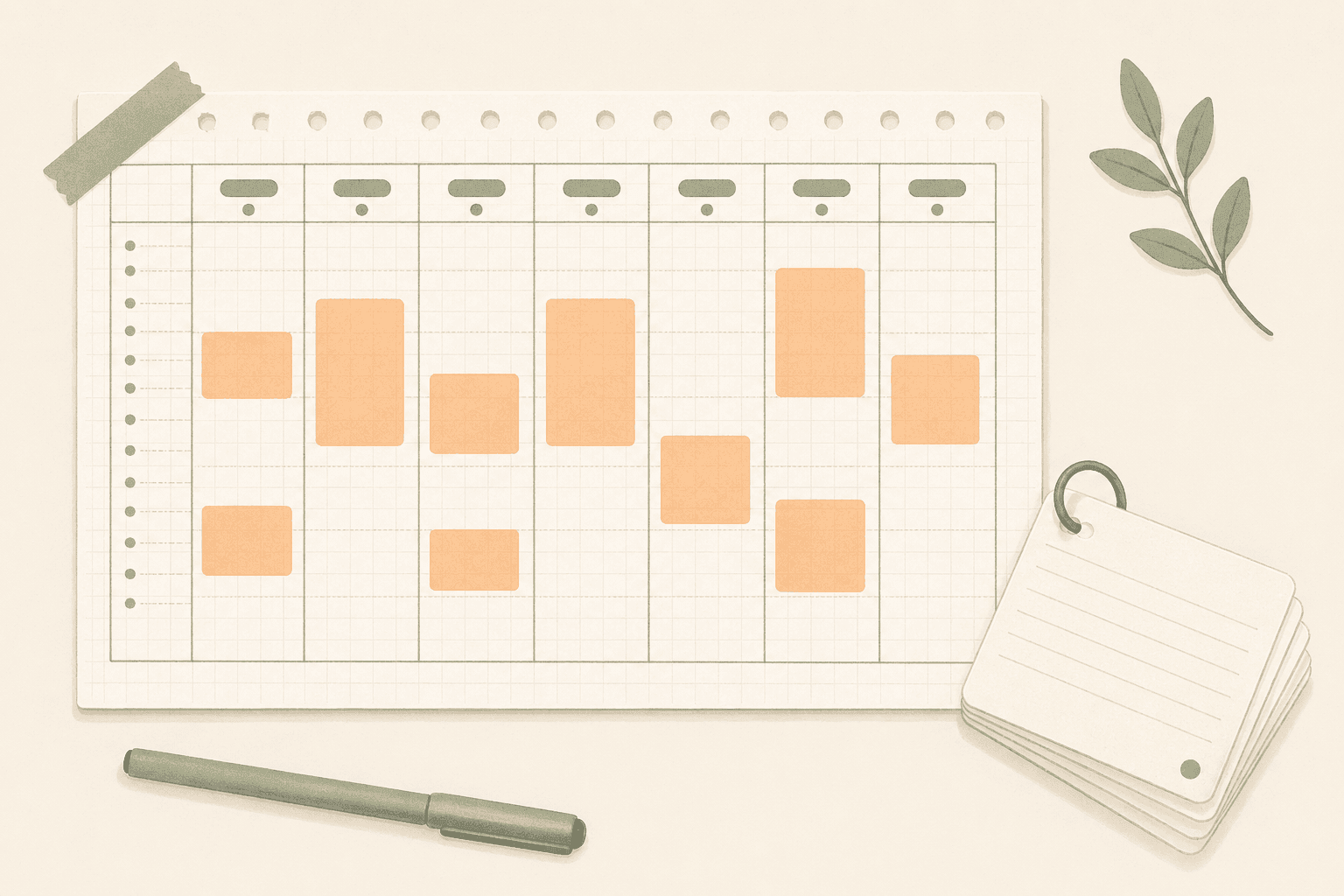
Step 1 — Audit Your Real Available Hours
Before scheduling anything, count the time you actually have. Singapore students typically spend 35+ hours in school, plus CCAs, travel, meals and sleep. Be honest about how many study blocks you can sustain on a school night — usually two 45-minute blocks, not four.
- Block out school, CCA, transit, meals and a fixed sleep window first.
- Mark non-negotiable rest: at least one full evening off per week.
- Whatever remains is your study budget. Plan within that, not against it.
Step 2 — Spread Topics Across the Week (Spaced Repetition)
Cramming a subject into one long Sunday session feels productive but produces the weakest retention. Research summarised by the U.S. Institute of Education Sciences shows that distributing the same study time across multiple shorter sessions can double long-term recall.
Schedule each major subject on three separate days per week instead of one big block. For O-Level and A-Level candidates following the Singapore Examinations and Assessment Board syllabus, this also gives time to sit with tricky topics rather than rushing them.
Step 3 — Replace Re-reading With Active Recall
Most students re-read notes and highlight — both feel useful and both rank near the bottom of effective study techniques. Active recall — closing the book and forcing yourself to retrieve the answer — is the single highest-yield habit you can install.
- Convert each chapter into 8–12 questions and answer them from memory.
- Use flashcard apps like Anki or Quizlet for vocabulary, formulas and dates.
- End every study block with a 5-minute self-test: what did I just learn?
Step 4 — Anchor the Plan With a Weekly Review
A timetable is a hypothesis. Every Sunday, take 15 minutes to ask three questions: What worked? What slipped? What needs more time next week? Adjust block lengths and topic frequency rather than abandoning the plan when it gets messy.
A Sample Weekday Template
- 4:00–4:30 pm — Snack, decompress, no screens.
- 4:30–5:15 pm — Active recall on yesterday's hardest topic.
- 5:15–5:30 pm — Movement break.
- 5:30–6:15 pm — New material from today's class, with self-test at the end.
- Evening — Light review only; protect sleep for memory consolidation.
Want Help Building Your Plan?
Our tutors design personalised timetables for every Gamma student during their first two weeks, then review them monthly. If you want this kind of structure for your child, get in touch with us or browse our current courses.